

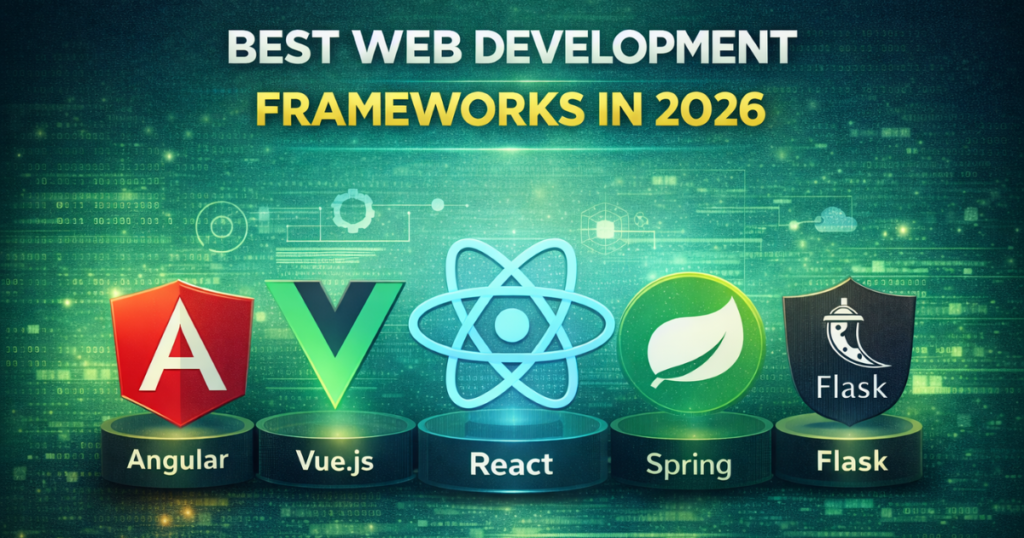
Many web development frameworks are available in the market today. Because of this, choosing the right framework can feel confusing for businesses and development teams. The best framework should match your business goals and remain easy to maintain for the next few years.
In this article, you will find a list of the best web development frameworks along with their features and ideal use cases. This will help you decide which framework suits your project requirements.
Vue.js
Evan You developed Vue.js in 2014. Vue.js combines the best features of AngularJS and React.js. It uses Angular’s view layer approach and React’s virtual DOM. Today, it has a strong and active developer community.
Features of Vue.js
-
Vue.js supports end-to-end application development similar to Angular.
-
It offers excellent documentation that simplifies JavaScript development.
-
Developers often choose Vue.js for fast and scalable web applications.
-
The framework supports two-way data binding and virtual DOM features.
When to Use Vue.js
-
When building progressive web applications
-
When SEO plays a key role in business growth
-
When faster development speed is required
Spring Framework
Spring was introduced in 2002 and has evolved into one of the most reliable Java-based frameworks. It works exceptionally well for enterprise-level and cloud-based applications.
Features of Spring
-
Spring supports server-side enterprise application development.
-
It uses dependency injection and annotations to simplify coding.
-
The framework supports cloud-native and event-driven applications.
-
It offers strong security and support for multiple data sources.
When to Use Spring
-
When working with Java-based enterprise applications
-
When building large-scale or CPU-intensive systems
-
When cloud computing is a priority
Express.js
TJ Holowaychuk created Express.js in 2010. It is a lightweight server-side framework built on Node.js. Express.js follows the MVC architecture and focuses on simplicity.
Features of Express.js
-
Express.js is a minimal and fast server-side framework
-
It supports routing, middleware, and templating
-
The framework performs well and remains stable for production use
Angular
Google introduced Angular in 2016 as a successor to AngularJS. It is a TypeScript-based framework designed for large-scale and complex applications.
Features of Angular
-
Angular offers strong security with built-in DOM sanitization
-
It supports web, mobile, desktop, and native app development
-
The framework works well for enterprise-grade applications
When to Use Angular
-
When you have an experienced development team
-
When building complex and feature-rich applications
-
When one framework is needed for multiple platforms

React.js
React.js is a JavaScript-based framework used mainly for building user interfaces. Its flexibility and performance have made it extremely popular worldwide.
Features of React.js
-
React focuses on the view layer of applications
-
It supports web, mobile, and desktop interfaces
-
The framework offers server-side rendering for better SEO
-
One-way data binding improves performance and control
Flask
Armin Ronacher developed Flask in 2010. Flask is a lightweight Python-based web framework. As Python continues to grow in popularity, Flask adoption is also increasing.
Features of Flask
-
Flask is a micro-framework and not a full-stack solution
-
It uses Werkzeug for HTTP handling and Jinja2 for templates
-
The framework works well for server-side applications
When to Use Flask
-
When building small or simple applications
-
When Python integration is required
-
When setting up lightweight or serverless solutions
Final Thoughts
Each web development framework has its own strengths. The right choice depends on your project size, performance needs, and future scalability. By understanding these frameworks and their use cases, you can select a solution that aligns with your long-term goals.