
Choosing a website for business or personal use can feel confusing. You usually have two main options: a single-page website or a multi-page website. Many businesses prefer multi-page websites because they help them grow faster. Let’s understand what a multi-page website is and why it is popular.
Multi-Page Website
A multi-page website contains several separate pages. Each page focuses on a specific topic, such as Home, About, Services, Products, or Contact.
Businesses choose multi-page websites because they can manage large amounts of content easily. Unlike single-page websites, where everything appears on one page, multi-page websites organize information clearly.
Now let’s look at why multi-page websites are popular.
Multi-page websites allow you to divide your content into different sections. This structure makes the website look professional and organized.
They work well for almost every type of project. They are especially popular for e-commerce websites because they allow businesses to create separate product categories, product pages, and checkout pages.
Navigation plays an important role in their success. Good navigation helps users find what they need quickly. For example, if someone visits an online clothing store, they do not want to scroll through unnecessary content. A clear menu allows them to go directly to the product category and complete their purchase easily. This improves user experience and increases sales.
Multi-page websites also support better SEO. You can target different keywords on different pages. More pages mean more content, and more content increases your chances of ranking higher in search engines. Many large brands and e-commerce companies prefer multi-page websites for this reason.
You can also update and redesign individual pages whenever needed. This flexibility helps you improve SEO and user experience over time.
Disadvantages of Multi-Page Websites
Although multi-page websites offer many benefits, they also have some drawbacks.
You must update them regularly. Managing several pages requires time and effort. You need to update content, improve design, and optimize keywords. Compared to single-page websites, multi-page websites usually cost more to build and maintain.
If you do not optimize the website properly, loading speed can become an issue. Large images, videos, or poor hosting can slow down the website.
Mobile responsiveness is also important. If developers design the website mainly for large screens, users may face issues on mobile devices. However, proper responsive design can solve this problem.
Why Choose a Multi-Page Website?
If you want to grow your business online, a multi-page website is a strong option. It helps you:
-
Organize content clearly
-
Improve SEO
-
Add multiple services or products
-
Provide better navigation
-
Expand your business easily
Users can find contact details, product information, and services without confusion.
Difference Between Single-Page and Multi-Page Websites
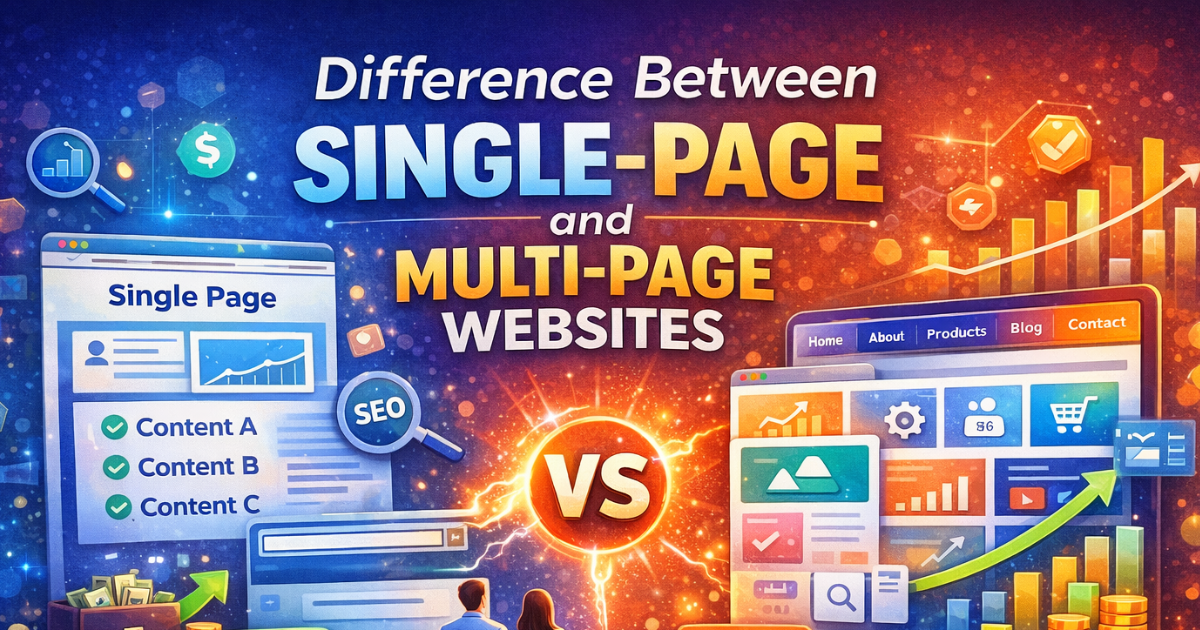
A single-page website contains all content on one page. You must manage everything in one long layout. These websites work well for portfolios, small projects, or simple information pages.
However, they offer limited SEO opportunities and limited space for expansion.
A multi-page website contains multiple structured pages. It suits businesses that want long-term growth. You can target different keywords, add new services, and expand your website as your business grows.
Single-page websites are easier to manage and usually cost less. Multi-page websites require more maintenance and strategy.
Both types have advantages and disadvantages. However, if your goal is marketing, scaling, and building a strong online presence, a multi-page website offers more flexibility and growth opportunities.
No matter which option you choose, always focus on high-quality content. Content plays a key role in attracting and retaining customers.